The Art of Writing Reasonable Organic Reaction Mechanisms Solutions Manual
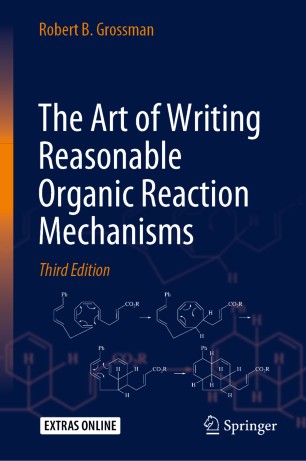
The Art of Writing Reasonable Organic Reaction Mechanisms, 3rd edition
(or, How to Laissez passer Your Cumes)
by Robert B. Grossman
[Previous versions of this page translated into: ]
You tin order The Art of Writing Reasonable Organic Reaction Mechanisms, third edition, from publisher Springer, Amazon.com, or other vendors for $84.99 or less. (Shop around; you can usually find it on auction somewhere. In order of decreasing cost, hardcover, softcover, and electronic versions are bachelor.)
I teach a ii-twenty-four hours "brusk course" based on this book that is intended for BS- and MS-level organic chemists and PhD-level analytical and biological chemists and chemical engineers in the pharmaceutical and contract synthesis industries. Please contact me if you are interested in bringing me to your company's site to teach the course.
- Web-based, interactive end-of-chapter issues!
- Table of Contents (3rd edition).
- Answer keys for all problems.
- 3rd edition: On each linked folio below, roll down to the link underneath Supplementary fabric beginning with 61032.
- Chapter 1
- Chapter 2
- Chapter 3
- Affiliate 4
- Chapter 5
- Chapter half dozen
- Chapter 7
- 2nd edition
- 1st edition
- 3rd edition: On each linked folio below, roll down to the link underneath Supplementary fabric beginning with 61032.
- Errata.
- 3rd edition
- 2nd edition
- 1st edition
- Published reviews.
- 2nd edition.
- J. Chemical Educational activity 2003, 80, 1259 (by Robert W. Holman)
- Synthesis 2003, 2751 (by T. Lazar)
- Chemistry in Commonwealth of australia 2003, 34 (by Helmut Hügel)
- 1st edition.
- Angewandte Chemie 2000, 39, 641 (by Jens Hartung)
- Synthesis 2000, 1497 (by Amy Howell)
- Phytochemistry 2002, threescore, 99 (by Michael Cooke)
- 2nd edition.
- Online reviews by customers.
- At Amazon.com
- At GoodReads.com
- Students' testimonials.
- Online references.
- Master Organic Chemical science: Grossman's Rule
- Twitter thread, early December 2019
The goal of The Art of Writing Reasonable Organic Reaction Mechanisms (AWRORM) is to teach students how to draw reasonable mechanisms for organic reactions, using the reaction atmospheric condition and the nature of the starting materials as a basis for the mechanism. The full general approach of the book is to allocate reactions according to their mechanisms and the reaction atmospheric condition under which they proceed, not according to the transformations they attain.
AWRORM'south level of difficulty is advisable for students who accept taken ii semesters of organic chemistry. It is not a new or supplemental textbook for sophomore organic chemistry, nor is it a reference text for students who have already mastered all the intricacies of writing mechanisms. AWRORM assumes that students have a basic knowledge of the conventions of cartoon organic structures. However, it too assumes that the students accept had very fiddling instruction in mechanistic concepts like nucleophilicity, electrophilicity, and the nature of radical concatenation reactions.
AWRORM has a number of features that make it different from all the other mechanism textbooks on the market.
- AWRORM is very much a practical, "how-to" book that is meant to show the pupil how to think logically and analytically near organic reaction mechanisms. Students are asked to larn how to draw reasonable organic mechanisms for sure reactions; where more than one reasonable mechanism can be written, students are not asked to learn that one is "correct" and the other is "wrong." Practical advice is provided to the student on things to exercise and non to exercise when drawing mechanisms. "Common error alerts" are scattered throughout the text to warning students to mutual mistakes and to show how they tin can avoid them. Worked and unworked examples of each mechanistic type are presented in each section so that the student develops a experience for the near common mechanistic pathways. An overview of the most important points is provided at the finish of each chapter.
- AWRORM is organized to reflect ane's thinking equally 1 puzzles through a problem. My philosophy is that a proposed organic chemistry machinery should flow naturally from the nature of the starting materials and the reaction conditions, and the book is organized to reflect this philosophy. For example, almost textbooks discuss electrophilic aromatic exchange and nucleophilic effluvious substitution in the same chapter. By contrast, AWRORM covers nucleophilic effluvious substitution immediately after it covers substitution at carbonyl compounds, because the mechanisms are identical; electrophilic aromatic substitution is discussed in a dissimilar chapter.
- AWRORM is tightly focused. Discussions of theory are kept to a minimum unless the theory impinges directly on how i would draw a mechanism for a reaction in question, and discussions of why reactions cull 1 course out of many possibilities are also generally omitted (with a few major exceptions). AWRORM is definitely not meant to introduce students to the methods by which mechanisms are determined experimentally (physical organic chemistry), so no discussion of kinetic assay, isotope effects, Hammett plots, etc. is included. AWRORM is also definitely non intended to teach students how to plan a synthesis.
- At the end of each chapter is a comprehensive problem fix. All problems are drawn from the literature. They vary in difficulty from easy to very challenging, just most can be solved past any student (not merely a very talented one) who has made a sincere effort to master the material. (AWRORM is superior to many other textbooks in this regard.) An respond key is provided in a separate book that can exist downloaded direct from Springer at no additional cost, and the solutions therein are written in such a way as to show the student how the answers tin can exist puzzled out.
New! You tin can now work the AWRORM stop-of-affiliate problems in ACE Organic, a Web-based, interactive organic chemistry homework programme that tells you why your mechanism is reasonable or unreasonable without giving abroad the right answer.
- The material covered in AWRORM reflects the breadth of modern organic chemistry. The book is non meant to exist completely comprehensive, just an endeavor is made to cover the important areas of organic synthesis. Reactions which are non used widely or have been largely supplanted are by and large not discussed, and newer reactions and reagents are often mentioned. For example, cycloaromatizations are discussed as a fundamentally new method for generating radicals. At the same fourth dimension, the importance of classical chemistry in modern synthesis is not ignored.
- A unique characteristic of this book among organic mechanism books is the inclusion of a affiliate on transition-metal-mediated and -catalyzed reactions. A working knowledge of the mechanisms of these reactions is indispensable to the practicing organic chemist, yet they are normally not discussed in organic chemistry textbooks or classes. Organometallic textbooks cover these subjects in item, but usually from the perspective of an inorganic chemist, not from that of an organic pharmacist trying to puzzle his or her mode through a machinery.
Please note: AWRORM is non a physical organic chemistry textbook! It is my experience that students cannot larn physical organic chemistry, the experimental methods past which proposed organic reaction mechanisms are tested, if they cannot suggest a reasonable mechanism for an organic reaction in the first place. AWRORM is intended to be used in a grade that intervenes betwixt sophomore organic chemistry and physical organic chemistry. It is not intended to replace textbooks such as Lowry & Richardson, Carey & Sundberg Role A, or Carroll. Many schools do non offer a course in "electron-pushing", expecting their graduate students either to have learned this material as an undergraduate or to selection it up on their own; students at schools such equally these would benefit greatly from studying AWRORM on their own.
Past the time yous have finished studying AWRORM, you should have a much improve understanding of why organic reactions proceed in the style they do. Yous should too find it much easier to pass your cumes (written qualifying examinations)!
Learn more about Robert B. Grossman or his research program in constructed organic chemical science.
Source: http://www.uky.edu/~rbgros1/textbook.html
Post a Comment for "The Art of Writing Reasonable Organic Reaction Mechanisms Solutions Manual"